One of the most persistent misunderstandings in organizational life is the belief that culture can be changed by announcing a strategy, rewriting values, or bringing in new leadership. It cannot. Culture is not what an organization says it is. Culture is what the organization structurally makes possible, day after day, over time.
To understand why this is true, two frameworks are essential: Robert Dilts's model of neurological levels, which describes how culture is layered, and Eric Liu's taxonomy of power sources, which describes what drives organizational behavior beneath the surface. Together, they explain both the failure of classical political organizations and the logic behind the incubator model.
The Dilts Model: Culture Has a Foundation
Robert Dilts, drawing on earlier work by Gregory Bateson and others, proposed that human and organizational behavior is organized in a hierarchy of logical levels. Each level shapes the levels below it, and each level requires the support of the levels beneath it to be sustainable.
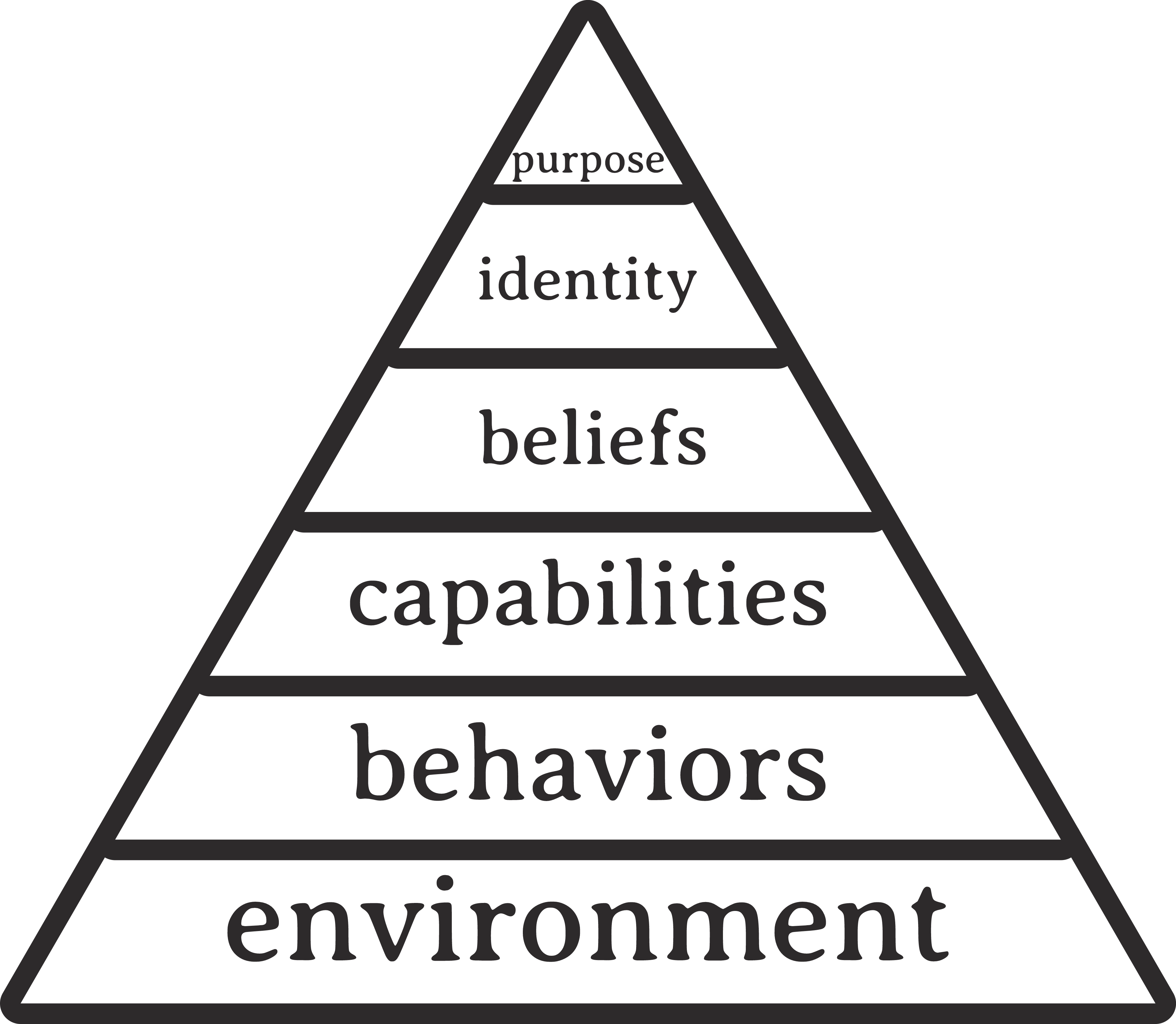
Reading the pyramid from the bottom up:
- Environment: the physical and structural context - where and when work happens, what tools exist, how spaces are organized, what processes are in place.
- Behaviors: what people actually do inside that environment. Behaviors are shaped by the environment - what the space makes easy, visible, or rewarded.
- Capabilities: the skills and habits that emerge from repeated behavior. You become capable of what you practice. You lose capability for what the environment never requires of you.
- Beliefs: what people come to believe about how things work, what matters, and what is possible. Beliefs are formed through experience, not through declarations.
- Identity: the sense of who we are within the organization, what role we play, what kind of contributor we are.
- Purpose: the deepest level - why we are here, what we are ultimately trying to produce in the world.
The critical insight: higher levels of the pyramid cannot be sustained without the lower ones. You cannot declare your way to a purposeful, identity-rich culture. You can only build it from the bottom, by designing the environment that produces the behaviors that build the capabilities that eventually make beliefs and identity real.
Peter Drucker put it concisely: "Culture eats strategy for breakfast." Strategy operates at the level of beliefs and purpose. Culture operates at the level of environment and behavior. When the two are misaligned, the deeper layer wins. Every time.
It is also why the principle holds: the environment that made you ill cannot heal you. Changing the values statement while leaving the structural environment intact produces the same behaviors, the same capabilities, the same beliefs - just with a new logo.
What This Means for Political Organizations
When someone enters a political organization for the first time, the first thing they encounter is not its purpose, not its identity, not even its beliefs. They encounter its environment: the meeting room, the hierarchy, who speaks and who defers, what tools exist, what processes are in place, who has access to what.
That environment immediately begins training behavior. If the environment rewards deference to authority, deference becomes a behavior. If the environment rewards contribution to specific problems, contribution becomes a behavior. If the environment has no mechanisms for recognizing quality work, the behavior of doing quality work, with no feedback, no reward, no visibility, quietly extinguishes itself.
Classical political organizations were designed for a 19th-century environment: mass illiteracy, slow communication, centralized coordination as the only viable model. That environment produced specific behaviors: top-down decision-making, loyalty as the primary currency, conformity as the survival strategy. Those behaviors, repeated over generations, became capabilities. Those capabilities produced beliefs. Those beliefs became the identity of the organization. That identity shapes what kind of purpose such organizations can even articulate.
You cannot fix this by changing the purpose statement. You fix it by redesigning the environment.
Power: The Energy That Runs Through the Pyramid
Understanding culture requires understanding power, not as something dark or shameful, but as the diverse set of forces that actually drive organizational life. Eric Liu, founder of Citizen University and author of You're More Powerful Than You Think, offers a clear and practical taxonomy.
Eric Liu - Why ordinary people need to understand power · TED
Liu identifies six sources of power:
Physical force
Coercion and violence. The oldest and most visible source of power, and the one democratic systems are designed to constrain.
Wealth
Resources, funding, economic leverage. Access to money determines access to action, in both business and political environments.
Law and institutions
State action, formal rules, and the authority to enforce them. Political organizations seek this form of power through elections.
Ideas
The capacity to shape what people think is possible, desirable, or true. The most underestimated source of power, and the one the incubator model is explicitly designed to cultivate.
Social norms
The unwritten rules that govern behavior: what is acceptable, expected, admired, or shameful. Culture, in the Dilts sense, operates largely through this source.
Numbers
Mass participation and legitimacy. The scale of organized people willing to act together. Democratic institutions are built on this form of power.
These sources interact and convert into one another. Financial resources can amplify ideas; mass participation can reshape social norms; law can institutionalize norms or suppress them. Understanding the power distribution within any organization, which sources are concentrated, which are absent, where leverage can be built, is a practical analytical tool, not an abstract political exercise.
In most classical political organizations, power clusters around wealth and numbers (membership scale, donor relationships) while ideas and social norms are either underused or actively distorted. The organization accumulates the forms of power that feed its hierarchy while starving the forms of power that would feed its mission.
Why Incubators Are Triangles

The triangle shape used throughout the incubator model is not decorative. It is a deliberate reference to the Dilts pyramid, a visual argument about organizational design.
An incubator is, by definition, an environment. Its first task is to create the structural conditions, the base of the triangle, within which specific behaviors become possible: multidisciplinary collaboration, evidence-based analysis, transparent contribution, iterative development. Those behaviors, practiced consistently, build genuine capabilities. Those capabilities produce beliefs that are earned rather than declared. That earned belief system develops organizational identity. And from that identity, purpose becomes real rather than aspirational.
This is the full Dilts stack, built from the bottom, within the bounded space of a single incubator focused on a single clearly defined problem. The triangle is not just the shape of the pyramid. It is the claim that a good organizational environment, designed deliberately and protected structurally, is the only reliable path to the purpose at the top.
The flowerpots on the book cover are triangular for this reason. The incubator is the pot. The idea is the plant. The environment is what makes growth possible.
Power flows toward good ideas only when the organizational environment is built to recognize them. An incubator is that environment, designed from the ground up, not from the top down.