Watch how a typical political organization structures itself and you will see something familiar. There is a health committee. A justice committee. A committee for the economy, one for education, one for agriculture. The structure is recognizable because it is a copy of the state apparatus the organization hopes one day to govern.
When the structure of an organization mirrors the state, its committees begin to function like proto-ministries: siloed, territorial, and organized around their own professional identity rather than around the problems citizens actually face. The committee becomes the point. The problem becomes secondary.
Problems Don't Know Which Committee to Call
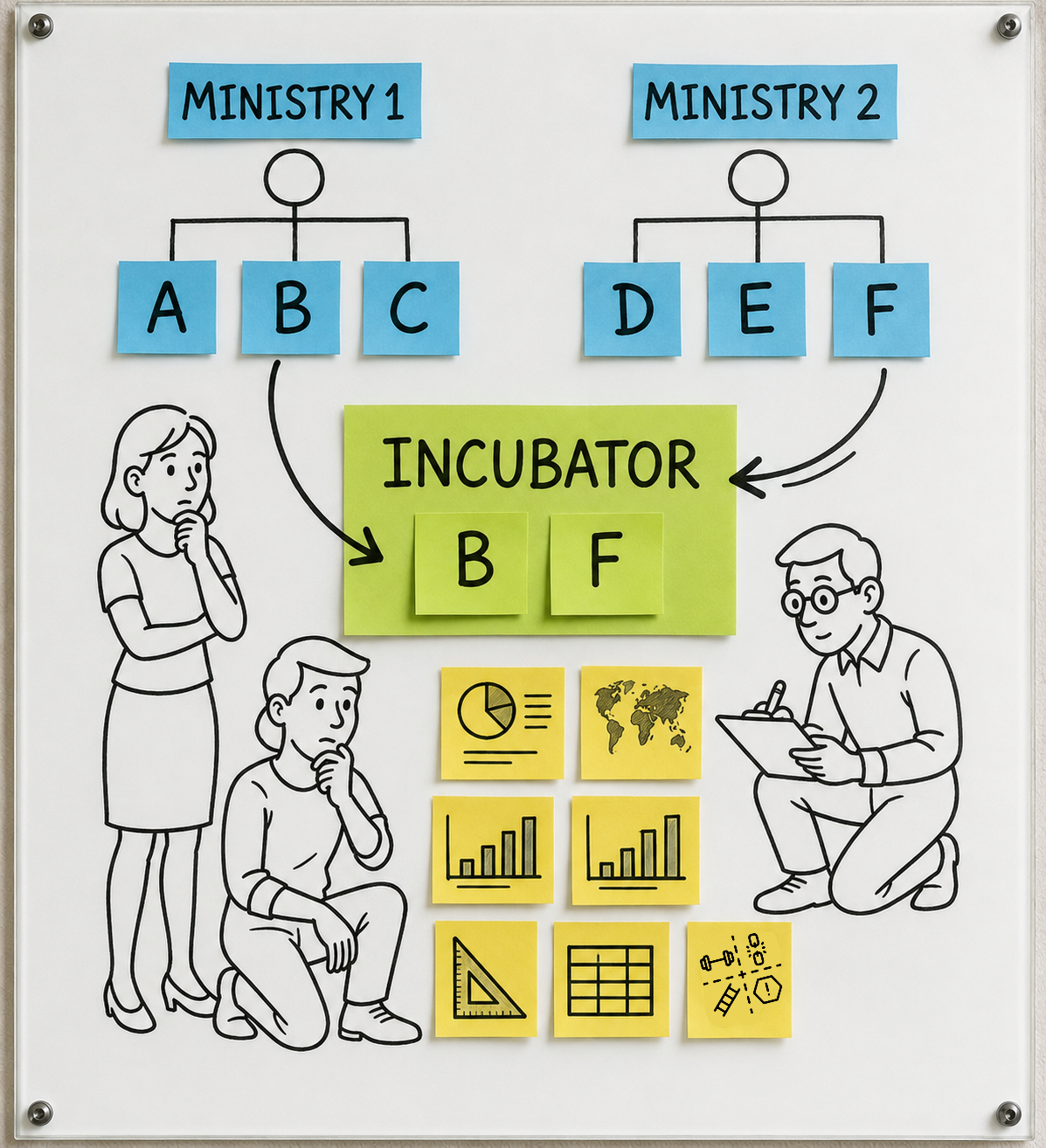
Take femicide. It cannot be meaningfully addressed through a single committee, no matter how well-intentioned. A serious approach requires coordinated work across medicine, criminal law, policing, psychology, education, social work, housing policy, labor economics, and local community structures. These are not parallel contributions - they are interdependent. A legal framework without psychological support services fails. Better policing without economic safety nets fails. Every single-discipline approach eventually hits the wall that the other disciplines were holding up.
"Contemporary problems are too complex to be solved without collaboration across disciplines and diverse lived experiences. This is essential for avoiding traps of superficiality."
Medicine Learned This the Hard Way
For most of medical history, patients were treated by a single specialist: whoever their primary diagnosis belonged to. When a patient had overlapping conditions, they moved between specialists sequentially, each working from their own expertise, rarely coordinating with the others. Important interactions were missed. Patients fell through the gaps between disciplines.
Medicine's response was the consilium: a structured meeting of specialists assembled around a single patient's case, making coordinated decisions together, because the problem - not the specialty - becomes the organizing principle. The key limitation is that consiliums typically appear late, after single-discipline approaches have already failed. The incubator model deploys that same multidisciplinary logic from the beginning, not as a rescue mechanism, but as the default structure.
What an Incubator Makes Possible
The incubator model proposes replacing permanent sector-based committees with open, problem-centric incubators. The difference is not cosmetic - it is structural. An incubator is defined by its problem, not its professional domain. It can be freely initiated by any member. It is multidisciplinary by design because the problem demands it. It operates transparently once it reaches meaningful participation and output, and its legitimacy comes from contribution and traction, not from hierarchy or appointment.
Compare two invitations: "Join our Health Policy Committee." Versus: "Join us to ensure ambulances reach every neighborhood in under 8 minutes."
One appeals to positional identity. The other appeals to purpose. One attracts people who want to be part of a structure. The other attracts people who want to solve a problem.
Closer to Open Source Than to a Party Congress
The organizational model that most closely resembles what incubators aim for is not the classic party - it is the open-source software community. Contributors organize around problems rather than hierarchies. Contributions are visible, debated, tested, and accepted only if they improve the solution. Entire operating systems have been built this way. The structural logic scales.
Society does not produce problems in ministries. It produces them at the intersection of poverty and housing, of mental health and criminal law, of education failure and economic exclusion. The organizations capable of addressing them need to be built around those intersections. The manifesto behind this proposal is built on exactly that logic: distributed power, multidisciplinary collaboration, and structures that cultivate good ideas instead of suffocating them inside inherited silos.